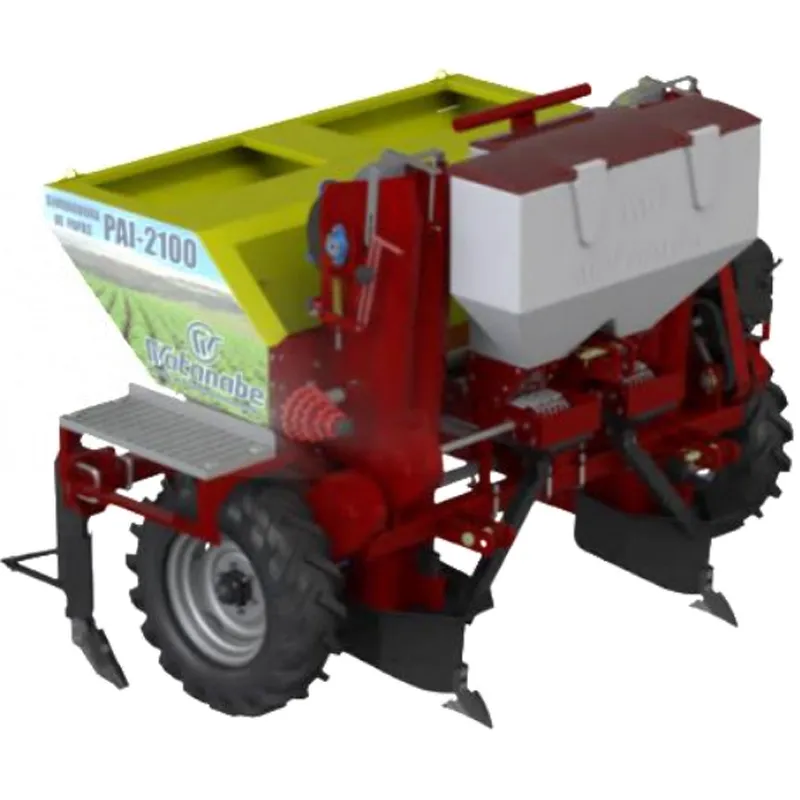
PAI-2100 Potato Planter 2 Rows
The PAI-2100 2-Row Potato Planter is an efficient agricultural machine designed for the Brazilian market, supporting precise seed placement, fertilizer application, and optional pesticide spraying. Compatible with tractors of 75 horsepower or more, it features a 350kg seed hopper and 200kg fertilizer hopper, with an operating speed of 3-5 km/h. Boost planting efficiency, reduce labor, and suit medium to large potato farms for uniform crop growth and sustainable farming.
Product Overview
The PAI-2100 Potato Planter 2 Rows is a high-performance agricultural machine designed for efficient potato planting operations in diverse soil conditions, particularly suited for the Brazilian market. Manufactured by Brazil Watanabe Soil Stabilizer Machine Co., Ltd., this planter integrates advanced engineering to ensure precise seed placement, fertilizer application, and optional insecticide distribution. It is compatible with tractors meeting minimum engine power requirements, making it an ideal choice for medium to large-scale potato farming in regions such as the Southeast and Cerrado areas of Brazil.
This machine enhances productivity by reducing manual labor and optimizing resource usage, contributing to sustainable farming practices. Key features include a robust bunker system for seeds and fertilizers, adjustable working speeds, and compatibility with standard tractor linkages.
Technical Specifications
The following table outlines the key technical data for the PAI-2100 Potato Planter 2 Rows, based on manufacturer standards:
| Category | Specification |
|---|---|
| Empty Weight | 860 Kg |
| Bottom Linkage Category | 2 |
| Number of Rows | 2 |
| Tractor Engine Power (Min.) | 75 cv |
| Bunker Capacity - Seeds | 350 Kg |
| Bunker Capacity - Fertilizer | 200 Kg |
| Tank Insecticide (Optional) | 200 L or 300 L |
| Working Speed | 3 - 5 Km/h |
Comparison with Similar Models
To provide a clear perspective on the PAI-2100's advantages, the table below compares it with a standard 2-row potato planter model commonly available in the Brazilian market (e.g., a generic semi-automatic variant) and a higher-end 4-row model for scalability reference. Data is derived from industry benchmarks and market analyses.
| Feature | PAI-2100 (2 Rows) | Standard 2-Row Planter | Advanced 4-Row Planter |
|---|---|---|---|
| Empty Weight | 860 Kg | 700 Kg | 1200 Kg |
| Minimum Tractor Power | 75 cv | 60 cv | 100 cv |
| Seed Bunker Capacity | 350 Kg | 250 Kg | 500 Kg |
| Fertilizer Bunker Capacity | 200 Kg | 150 Kg | 300 Kg |
| Optional Insecticide Tank | 200 L | Not Available | 300 L |
| Working Speed | 3-5 Km/h | 2-4 Km/h | 4-6 Km/h |
| Price Range (Estimated USD) | 39,000 | 25,000 | 55,000 |
| Efficiency Rating (Hectares/Day) | Up to 5 | Up to 3 | Up to 8 |
Key Benefits
- Precision Planting: Ensures uniform seed distribution, reducing waste and improving crop uniformity.
- Versatility: Suitable for various potato varieties common in Brazil, such as Asterix and Atlantic.
- Durability: Built with high-quality materials to withstand challenging terrains, including those requiring soil stabilization.
- Sustainability: Optimizes fertilizer and insecticide use, minimizing environmental impact in compliance with Brazilian agricultural regulations.
- Ease of Integration: Compatible with existing tractor fleets, facilitating seamless adoption in farms across São Paulo, Minas Gerais, and Paraná states.
Working Principle of the PAI-2100 Potato Planter 2 Rows
The PAI-2100 Potato Planter 2 Rows is a tractor-mounted agricultural implement designed for efficient and precise planting of potatoes in two parallel rows. It integrates mechanisms for furrow creation, seed placement, fertilizer application, optional insecticide distribution, and soil covering, all synchronized with the forward motion of the tractor. The machine operates at a recommended working speed of 3 to 5 km/h and requires a tractor with a minimum engine power of 75 cv, attached via a category 2 bottom linkage system. Below is a detailed explanation of its operational sequence, derived from standard engineering principles for similar two-row potato planters.
1. Attachment and Power Transmission
The planter is securely mounted to the tractor using a three-point hitch system, which provides stability and allows for easy height adjustment. As the tractor advances, power is transmitted from the ground wheels or the tractor's power take-off (PTO) to drive the internal mechanisms. This includes chain-and-sprocket systems that synchronize the metering devices with the machine's forward speed, ensuring consistent spacing and placement.
2. Furrow Opening
Shovel-type or disc furrow openers, positioned at approximately 60 cm spacing for the two rows, penetrate the soil to create parallel furrows. The depth of these furrows is adjustable, typically ranging from 5 to 10 cm, depending on soil conditions and potato variety requirements. This step prepares the planting bed by displacing soil to form channels suitable for seed and fertilizer deposition.
3. Seed Metering and Placement
Seeds are loaded into the dedicated seed bunker, which has a capacity of 350 kg. A cup-type metering mechanism, often consisting of a rotating chain with evenly spaced cups (e.g., oval-shaped metallic or rubber cups to accommodate various seed sizes), picks up individual seed potatoes from the bunker. As the chain rotates—driven by the ground wheel or PTO—the cups invert over a delivery chute, releasing the seeds into the open furrows at uniform intervals (typically 20-30 cm apart, adjustable based on calibration). This ensures minimal damage to the seeds and precise placement for optimal germination and growth.
4. Fertilizer Application
Concurrently with seed placement, fertilizer is dispensed from a separate bunker with a 200 kg capacity. A metering system, similar to the seed mechanism (e.g., via adjustable apertures or rotating discs), applies the fertilizer either directly into the furrow alongside the seeds or in a banded manner slightly below or beside them. This targeted application promotes efficient nutrient uptake while minimizing waste and environmental impact.
5. Optional Insecticide Distribution
If equipped with the optional 200 L insecticide tank, the machine incorporates a spraying system that dispenses liquid insecticide during the planting process. Nozzles positioned near the furrows ensure even coverage over the planted area, providing early protection against pests without requiring a separate pass.
6. Soil Covering and Ridging
Following deposition, ridger attachments or covering discs lift and return the displaced soil to cover the seeds, fertilizer, and any applied insecticide. This forms protective ridges over each row, typically 15-25 cm high, which help retain moisture, suppress weeds, and prevent exposure to sunlight. Pressing wheels or rollers may follow to firm the soil around the seeds, enhancing soil-to-seed contact for better root establishment.
The PAI-2100's design allows for single-pass operation, combining multiple tasks to reduce labor and time. Adjustments for planting depth, row spacing, seed rate, and fertilizer application can be made via mechanical levers or settings, calibrated according to field conditions, soil type, and crop specifications. Regular maintenance, such as lubricating moving parts and checking metering cups, ensures reliable performance. This principle aligns with modern sustainable farming practices, optimizing resource use and supporting high-yield potato production in diverse agricultural environments.
Industry Case Studies
To illustrate the practical application of potato planters like the PAI-2100 in Brazil, the following case studies highlight successful implementations:
- PepsiCo's Potato Crop Tropicalization Project (2023): PepsiCo partnered with 25 Brazilian potato farmers to implement advanced planting technologies, including automated planters. This initiative doubled productivity through precise seed and fertilizer placement, reducing water usage by 20% and increasing yields to 50 tons per hectare in tropical conditions. The project emphasized machine learning for soil analysis, aligning with the PAI-2100's capabilities for efficient resource management.
- CBA Sementes Aeroponic Seed Potato Production (2020): CBA Sementes licensed aeroponic systems integrated with ground planters to empower smallholder farmers in Brazil. By combining high-tech seed production with reliable 2-row planters, farmers achieved a 30% increase in seed quality and planting efficiency, leading to higher market value for crops. This case demonstrates the role of machinery in scaling sustainable potato farming.
- Technical and Economic Efficiency in Brazilian Potato Production (2023): A study analyzing determinants of efficiency in potato farming across Brazil found that mechanized planting reduced labor costs by 25% and improved technical efficiency scores to above 0.85. Farms using 2-row planters like the PAI-2100 reported higher economic returns, particularly in regions with variable soil quality, underscoring the importance of equipment investment for long-term profitability.
These examples showcase how adopting advanced planters contributes to enhanced yields, cost savings, and environmental sustainability in the Brazilian potato sector.
Frequently Asked Questions
What is the minimum tractor power required for the PAI-2100 Potato Planter 2 Rows?
The PAI-2100 necessitates a minimum engine power of 75 cv to achieve optimal operational efficiency. This specification ensures seamless compatibility with mid-range tractors prevalent in Brazilian agricultural practices.
Is the insecticide tank a standard inclusion?
The 200 L insecticide tank is provided as an optional component, enabling tailored configurations to address specific pest control requirements in potato farming operations.
How does the PAI-2100 perform across various Brazilian soil types?
Engineered with durable construction, the PAI-2100 demonstrates superior performance in diverse soil conditions, including those found in the Cerrado biome. It complements soil stabilization methodologies, which align with the core expertise of Brazil Watanabe Soil Stabilizer Machine Co., Ltd.
What maintenance procedures are recommended for the PAI-2100?
Routine maintenance entails inspections of bunker systems and linkage components. It is advisable to schedule annual professional servicing by certified technicians to sustain peak functionality.
Where can the PAI-2100 be acquired in Brazil?
Prospective purchasers may contact Brazil Watanabe Soil Stabilizer Machine Co., Ltd. directly through our official website or engage with authorized distributors located in key agricultural centers, such as São Paulo and Curitiba.
About Brazil Watanabe Soil Stabilizer Machine Co., Ltd.
Brazil Watanabe Soil Stabilizer Machine Co., Ltd. was established in 1970 by Mr. Hitoshi Watanabe in Castro, Paraná, Brazil. Initially serving as an authorized reseller of Hatsuta sprayers, the company evolved through close collaboration with farmers to address their specific needs, leading to the development of innovative agricultural machinery, including the first two-line potato harvester. With over 50 years of experience, the organization has become a trusted partner in rural production, emphasizing quality, reliability, and sustainable practices.
The company specializes in a comprehensive range of agricultural equipment designed to enhance efficiency and productivity across various farming operations. Key product categories include:
- Soil Stabilization and Pavement Line: Soil stabilizer machines for robust soil preparation and infrastructure support.
- Area Clearing Line: Stone crushers, rock rakes, rock pickers, and rotavators for land preparation and residue management.
- Potato Line: Potato furrowers, potato planters, potato diggers, and potato harvesters for mechanized potato cultivation.
- Livestock Line: Compost barns and related equipment for sustainable animal husbandry.
- Additional Offerings: Fertilizers, rotary cultivators, and complementary tools to support diverse agricultural requirements.
Guided by core values of respect, a profound appreciation for the land, and a commitment to advancing rural development, Brazil Watanabe Soil Stabilizer Machine Co., Ltd. maintains nationwide coverage in Brazil to serve farmers effectively.
Edited by CX